

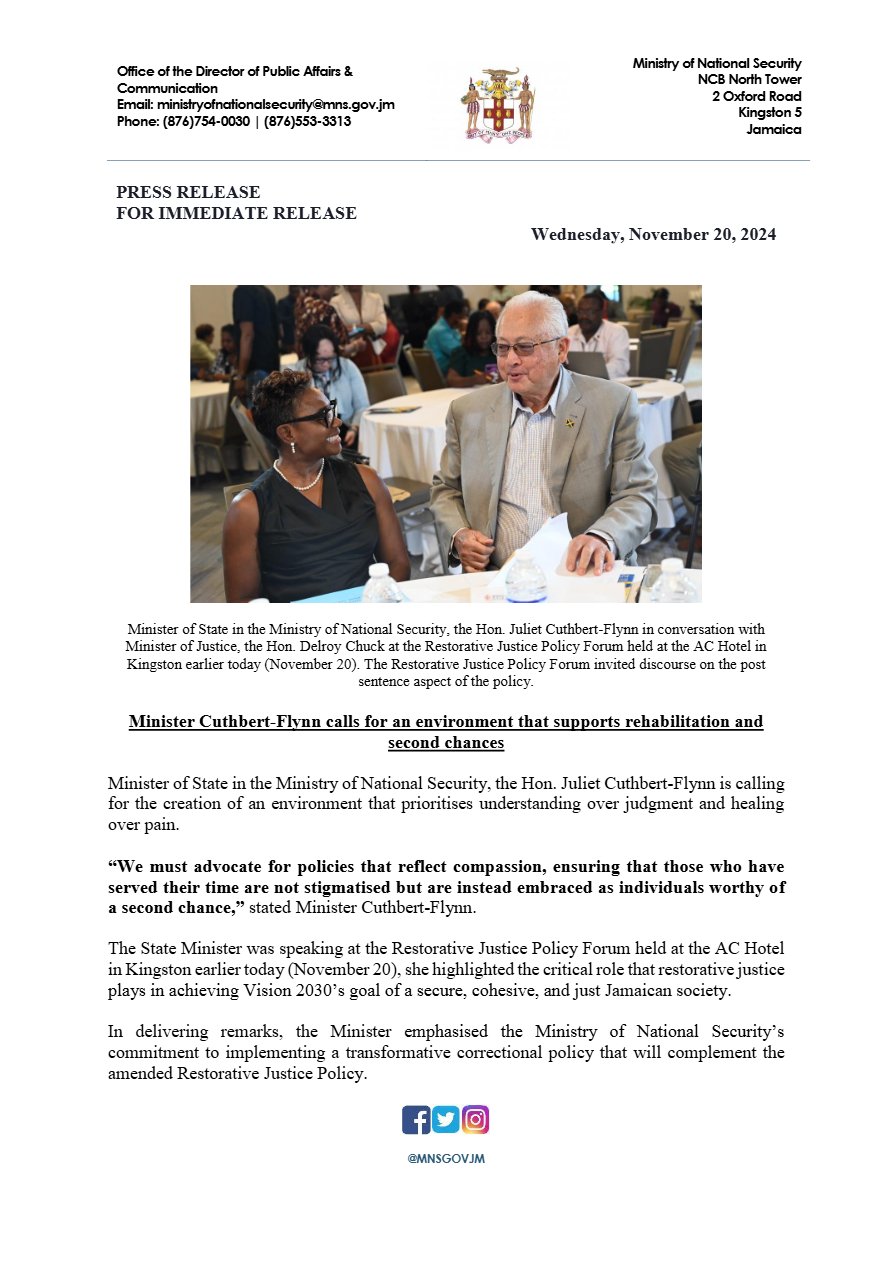
Minister of State in the Ministry of National Security, the Hon. Juliet Cuthbert-Flynn is calling for the creation of an environment that prioritises understanding over judgment and healing over pain.
“We must advocate for policies that reflect compassion, ensuring that those who have served their time are not stigmatised but are instead embraced as individuals worthy of a second chance,” stated Minister Cuthbert-Flynn.
The State Minister was speaking at the Restorative Justice Policy Forum held at the AC Hotel in Kingston earlier today (November 20), she highlighted the critical role that restorative justice plays in achieving Vision 2030’s goal of a secure, cohesive, and just Jamaican society.
In delivering remarks, the Minister emphasised the Ministry of National Security’s commitment to implementing a transformative correctional policy that will complement the amended Restorative Justice Policy.
“Restorative Justice offers us a pathway that prioritises reconciliation, understanding, and the restoration of relationships over retribution,” the Minister stated.
She further noted that Jamaica’s correctional framework must evolve from being punishment driven to one that promotes healing, accountability, and reintegration.
The Restorative Justice Policy (RJP) aligns with the objectives of the National Correctional Services Policy (NCSP) Green Paper, which is currently under public consultation. This NCSP underscores the Government's commitment to reducing recidivism through programmes that empower incarcerated individuals and prepare them for positive reintegration into society.
Minister Cuthbert-Flynn described the NCSP as a pivotal step in creating a corrections system that upholds restorative justice principles, fostering community involvement and support for individuals post incarceration.
Chief Technical Director of the Crime Prevention Rehabilitation and Inspectorate Policy Division in the Ministry of National Security, Shauna Trowers shared insights into the shared priorities of the RJP and the NCSP at the Policy Forum.
“The Ministry believes restorative justice is a tool in the rehabilitation process, and the aim in the process has to be to decrease recidivism and provide proper reintegration,” Trowers stated.
She stressed that both policies address critical gaps in the current system, emphasising the need to trigger restorative justice processes before parole to support smoother transitions for individuals leaving correctional facilities.
The Ministry of National Security views restorative justice as an indispensable tool in rehabilitation. According to Trowers, ensuring that individuals become productive and law-abiding citizens post-incarceration is central to this shared policy vision.
Programmes under the NCSP are tailored to align with restorative justice principles, integrating counselling, community participation, and skill-building initiatives that prepare individuals for life beyond correctional facilities.
The policy forum highlighted the necessity of inter-ministerial collaboration in achieving meaningful reform.
The Restorative Justice Policy’s successful implementation hinges on the integration of rehabilitation focused strategies under the purview of the Ministry of National Security. This partnership signals a collective effort to transform the correctional landscape in Jamaica, promoting healing and reducing stigma for individuals who have served their time.
As Jamaica progresses towards Vision 2030, the Ministry of National Security remains steadfast in its commitment to policies that reflect compassion and prioritise rehabilitation over punishment.
Photos
View album in the Gallery →