

Jamaica's investment in national security extends well beyond the figures attached to the annual budget. Over the last decade, the Ministry of National Security and Peace (MNSP) has overseen investments of more than $100 billion in infrastructure, technology, equipment, systems and programmes intended to strengthen the country's security architecture.
For the Ministry, however, the value of these investments ultimately depends on what they deliver.
This makes Project Management pivotal at every stage - from planning, coordination and utilization of resources, to risk assessment, proper management and oversight. It is central to the Ministry's efforts to strengthen how it translates policy and strategic priorities into tangible results.
Head of Enterprise Project Management within the Ministry, Mr. Thaddeti Tulloch, said the Enterprise Project Management Office (EPMO) provides that connection between both.
"For the Ministry of National Security and Peace, having an enterprise project management office means having an institutional mechanism that connects strategy to execution and execution to results," he explained.
Mr. Tulloch said that since 2016, the EPMO has provided a framework for translating the Ministry's policies and strategic priorities into programmes and projects that are properly planned, governed, implemented, monitored and evaluated. The approach, he shared, goes beyond ensuring that projects are completed.
"A new police station, a technology platform, a fleet of vehicles, a border management system or a new security capability is not by itself the final measure of success," he said. "We must go further and ask, is it being used effectively? Is it sustainable? Is it producing the intended benefits? And ultimately, is it creating value for Jamaica and the Jamaican people?"
That emphasis on outcomes is particularly important within the security sector, where projects operate in an environment characterised by multiple stakeholders, competing demands, finite resources and changing circumstances.
Mr. Tulloch said the EPMO therefore takes an enterprise-wide approach, providing governance and the necessary standards for oversight and performance monitoring across project life cycles.
This also allows the Ministry to realise the intended benefits of its portfolio of investments.
"In simple terms, the EPMO is a bridge between strategy and successful execution," he said. "We help the Ministry move from policy and ideas to projects, from projects to outputs, from outputs to outcomes and benefits, and ultimately from those benefits to sustainable public value."
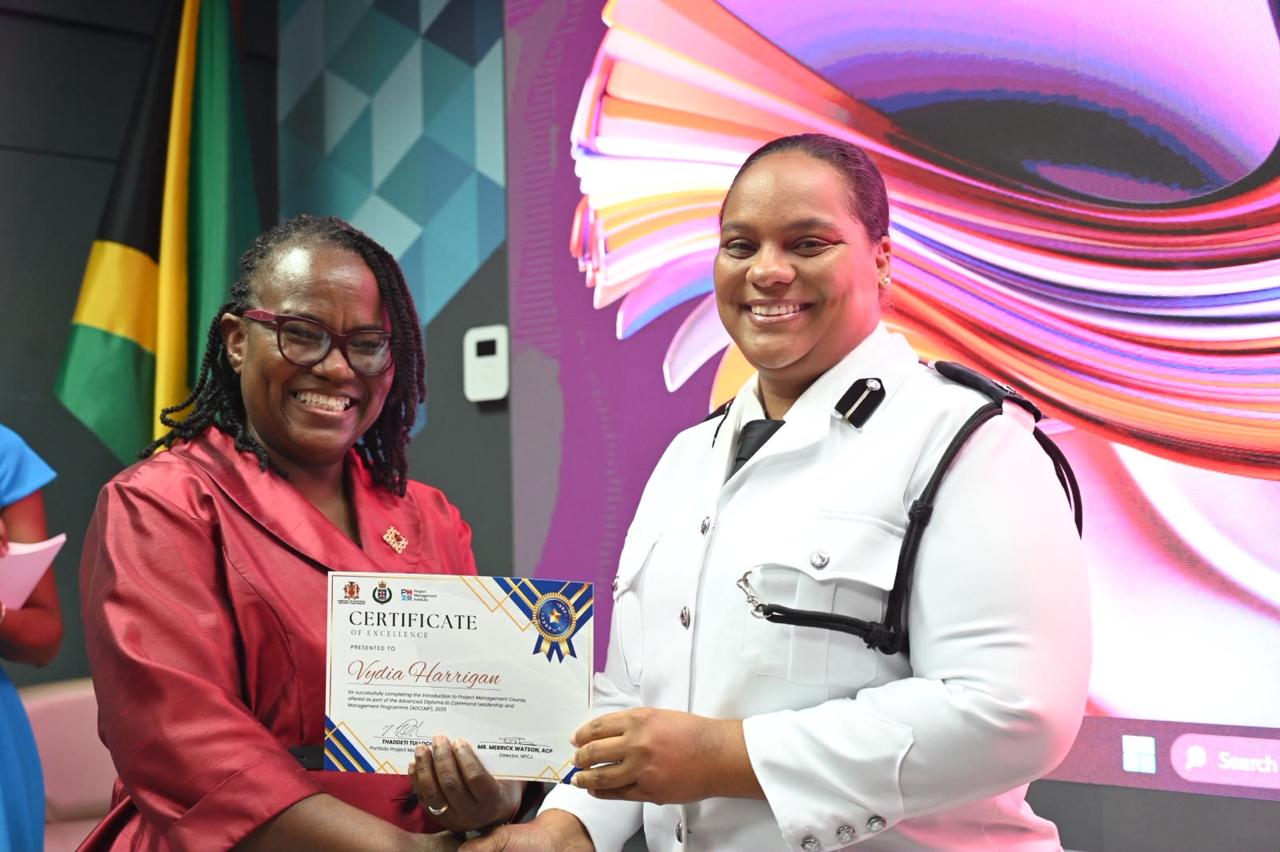
The Ministry has also been strengthening that capability through people. Forty-eight security-sector professionals recently completed project management training, marking another step in building a cadre equipped to apply recognised project management principles within their respective organisations.
Twenty-five members of the Jamaica Defence Force (JDF) underwent the Ministry's Professional Project Management Training Programme Project Management Professional (PMP) Preparation Course. A further 25 officers from the Jamaica Constabulary Force (JCF), Jamaica Fire Brigade (JFB), Department of Correctional Services (DCS) and Royal Anguilla Police Force, completed Introduction to Project Management through the National Police College of Jamaica's (NPCJ) Diploma in Command, Leadership and Management Programme.
Chair of the Ministry's Capital Monitoring Committee, Mrs. Karen Clarke-Davis, said the training is intended to strengthen the ability of public-sector professionals to "move an idea, policy or national priority into a properly planned, resourced, monitored and delivered project."
Referencing the scale of the Ministry's investments over the past decade, Mrs. Clarke-Davis asserted that the level of expenditure requires a disciplined approach to project delivery.
"When the numbers are that significant, we cannot afford to approach project delivery casually," she said, noting that project management is also a matter of governance, accountability and protecting public investment.
The Ministry's Capital Monitoring Committee provides oversight across projects, programmes and portfolios, while the EPMO serves as its secretariat and works to strengthen project management competence across the organisation.
The training, aligned with Project Management Institute standards, exposes participants to current project management practices, including both agile and plan-driven approaches. For professionals working in national security, that knowledge can be applied across a range of initiatives, from infrastructure and technology projects to programmes aimed at improving operational capability and public safety.
For the graduates, however, the value of the training extends beyond obtaining a certificate.
Captain Monique Rose Mullings, who delivered remarks on behalf of the JDF cohort at the Project Management Graduation Ceremony hosted on September 3, described the training as an experience that changed how participants approached projects and problems.
She said the programme helped participants develop what she described as a "project manager's mindset" - one that focuses less on assigning blame when something goes wrong and more on understanding the problem, identifying its root cause, assessing the available information and determining who needs to be involved.
The training also reinforced the need to adapt when circumstances change.
Captain Mullings noted that project plans, requirements, priorities and stakeholders can change, requiring project teams to inspect, adapt and continue delivering value rather than becoming overly attached to an original plan.
That mindset has practical relevance in the security sector, where projects can be affected by operational demands, emerging risks, changing priorities and resource constraints.
Director of the National Police College of Jamaica, Assistant Commissioner of Police Merrick Watson, said the training should therefore be reflected in how graduates approach their work. He challenged the graduates to "take the knowledge back to [their] organisations, share it with colleagues, question inefficient practices and help strengthen the discipline around project delivery".
The significance of the training therefore extends beyond the 48 professionals who received certificates and joined the more than 1,000 public-sector professionals trained in project management since 2017.
As these officers and professionals return to the JDF, JCF, JFB, DCS and other security-sector environments, they bring a common body of knowledge and a more structured approach to planning, implementation and monitoring.
That can strengthen the sector's ability to identify risks earlier, manage resources more deliberately, coordinate stakeholders and recognise when a project is moving away from its intended objective. It can also support greater consistency in how projects are planned and monitored across organisations that must frequently work together.
For Mr. Tulloch, the ultimate measure remains whether those capabilities produce meaningful benefits.
"Every dollar invested in national security must ultimately translate into capability," he added. "That capability must translate into benefits and those benefits must translate into measurable and sustainable value for the Jamaican people."
The investment in project management training is therefore not simply an investment in certification. It is an investment in the people responsible for turning significant public investments into functioning capabilities, stronger institutions and improved services for all Jamaicans.
As more professionals across the security sector develop that capacity, project management becomes more than an administrative function. It becomes part of the sector's ability to execute its priorities, manage complexity and ensure that resources committed to national security translate into a safer, more secure and peaceful Jamaica.